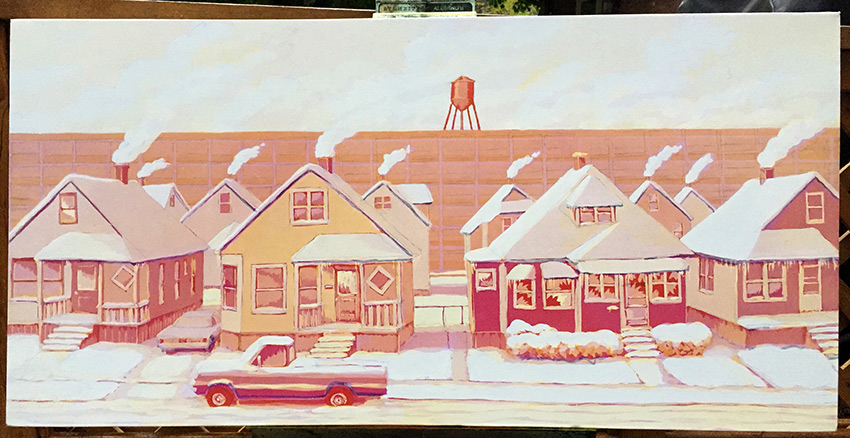
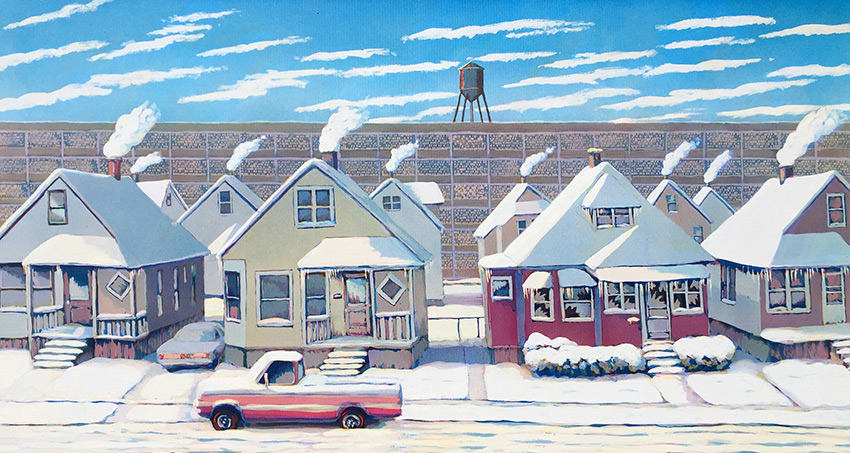
MicroPointillist Painting Demonstrated - The Painting of "Detroit Winter"
Painting "The Gentle Chaos" -- red phase
[Stuttgart 1992] Lowell Boileau
Microscopic points of the primary colors yellow, red and blue on a white surface are all my MicroPointillist paintings consist of.
This technique is called MicroPointillism. It was developed in 1979 by Detroit Artists Stephen Goodfellow and Lowell Boileau. As with 19th Century Pointillist painting, the viewing eye does the mixing of points of color to created the thousands of colors that appear. The only difference is that the points are microscopic and only the three primary colors are used.
HOW IT IS DONE
A MicroPointillist painting begins with a drawing on a white gessoed surface. In the demonstration that follows, it is on canvas.
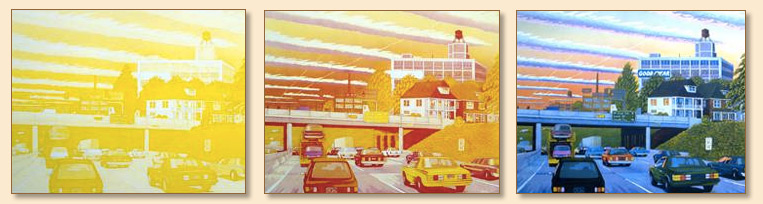
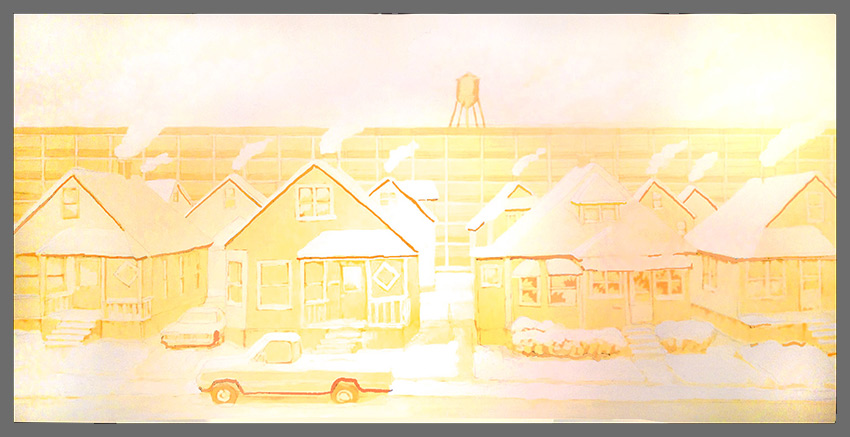
The first color, yellow, is then applied in stages to created shades of yellow.
[1]
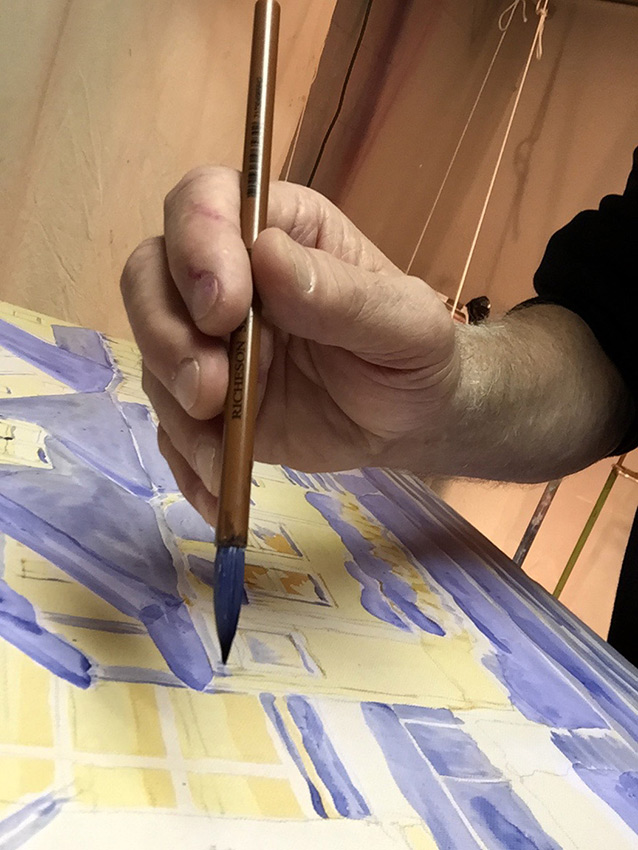
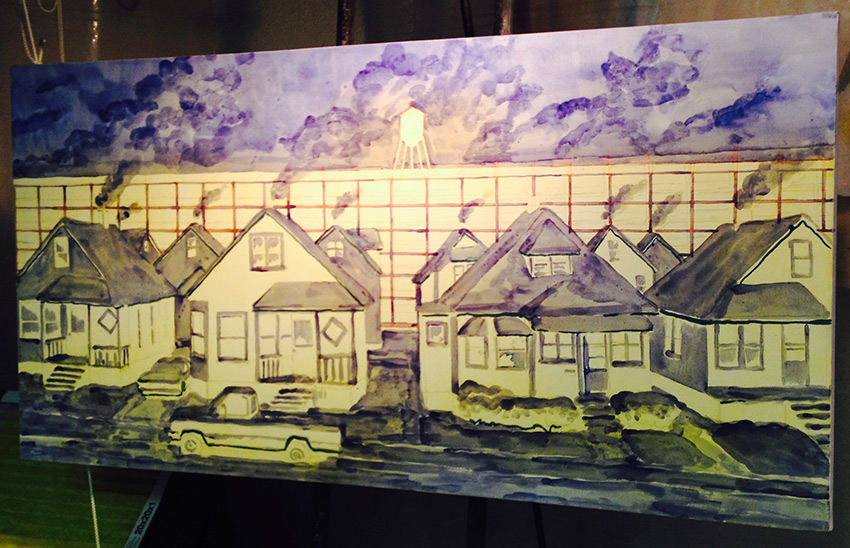
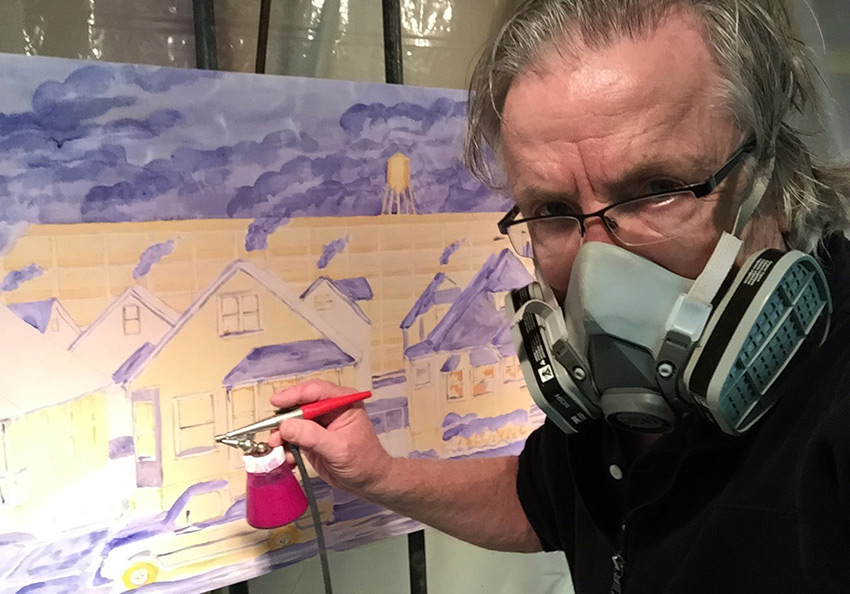
A water-soluable liquid masking solution is brushed on where yellow is NOT wanted or where enough yellow has been added.
The solution being used is silk screen block-out, tinted purple for visiblity. Think of it as liquid masking tape--what it covers will not be painted. When it is peeled away, dissolved by water in this case, the color it masked will appear as the ghost image of the brush stroke.
For example, what will become the pure white sunlit snow or chimney smoke is masked first so no yellow will fall on those areas.
I like to describe Micropointillist painting as 'backward painting' because you brush where you do NOT want paint, or don't want any more paint.
The brush strokes appear in reverse down to the finest hairs making it appear as if the paint was brushed on.
Obviously this requires understanding, gained over time, of how much yellow is needed to combine with red and blue to make the desired colors for various areas.
[2] When the masking solution dries, a light
spray of yellow paint is made over the entire surface of the painting
falling on both the masked and unmasked areas.
The canvas is further masked
and another light layer of paint is sprayed.
This process of masking
and spraying is usually repeated as much as six to twelve times per color.
With each new masking additional parts
of the painting are shielded leaving the remaining unmasked areas to
become darker yellow.
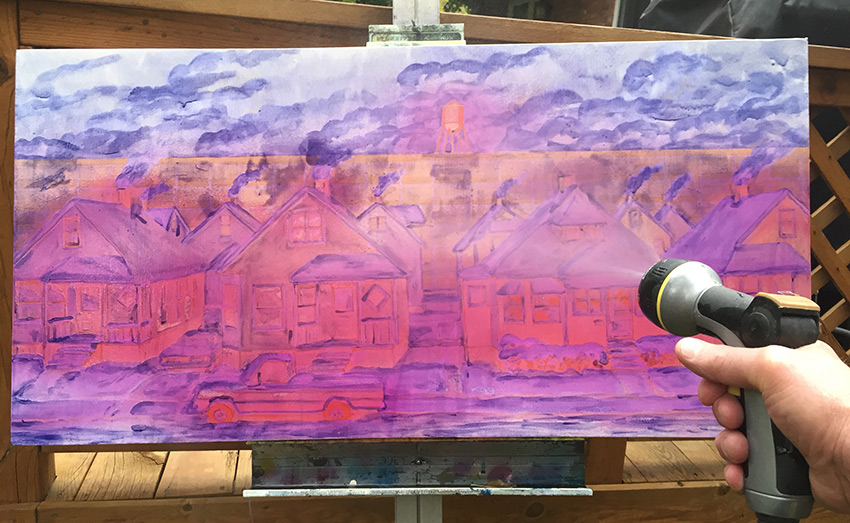
The canvas is then hosed down water. The water-soluable
maskings dissolve away and reveal the painting in shades of yellow,
plus white (in the areas that were masked before any yellow was sprayed).
[3] The red phase follows. The first thought is, "In what areas do I not want any red--such as the bright sunlit snow." Those will be masked before any red is sprayed on. Then the same procedure, as with the yellow phase, of masking and spraying several layers proceeds.
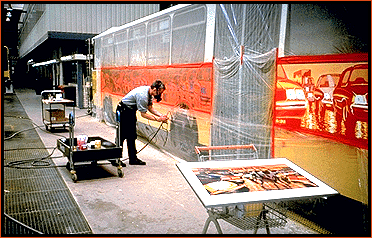
Below: Red is being sprayed on between maskings.
[4] Actual painting, the applying of the color, is the easy part of MicroPointillist technique. The exposed are areas are evenly sprayed until a point is reached where some part of the painting needs to be masked so that it gets no more red.
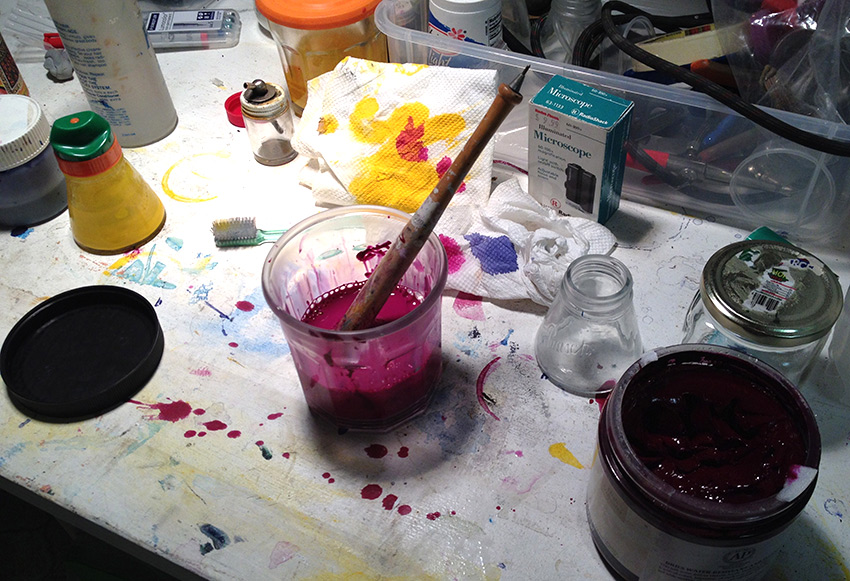
[5] Another easy part of Micropointillist painting is mixing the paint. Only three colors need be mixed to the consistency of milk.
In this painting I used cadmium yellow, quinacridone violet [shown being mixed here] which is more of a magenta than a violet, and phthalocyanine blue as my primary colors.
Over time these have evolved as the best combination due to the rich intensity of each color but other variations of the three primary colors can work.
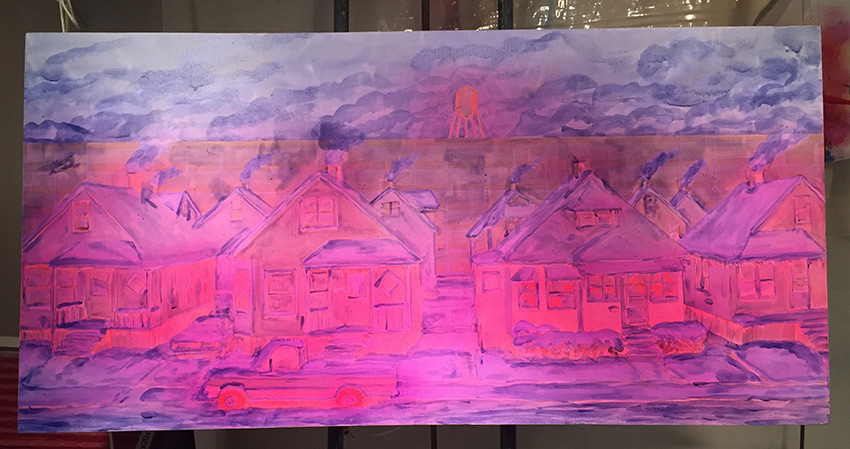
[6] Above: The masks of the red phase are ready to be washed off. Only the areas of the most dense red remain unmasked.
[7] The water-soluable mask is dissolved away, mostly by hosing it away followed by some sponging to remove any stubborn spots.
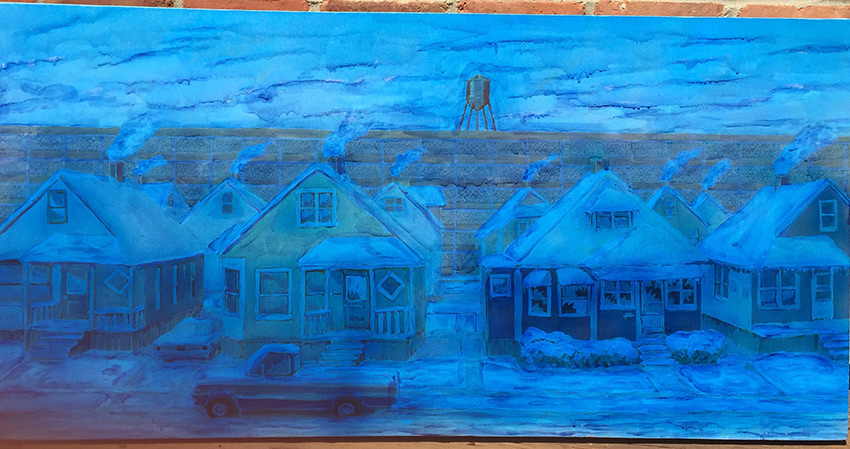
[8] Once the red phase mask is washed off, the structure of the painting becomes distinct. Masking of the final blue phase follows.
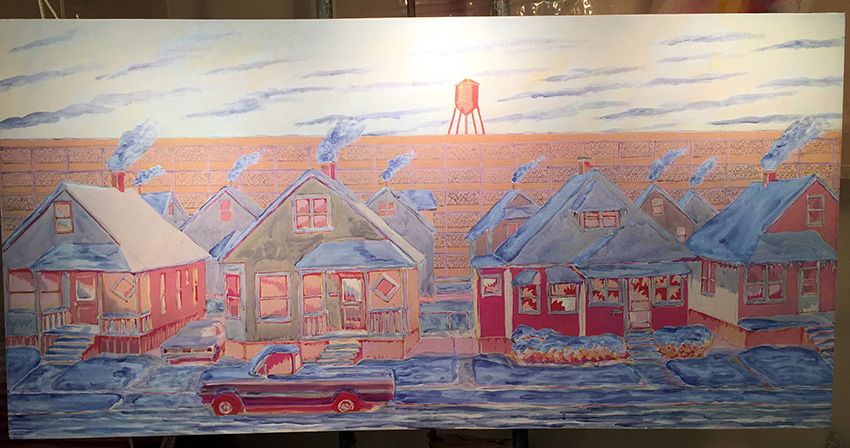
Any color that is to remain purely as seen here will be masked first, like the pure whites of the sunlit snow. The second house on the left which will be a lime green will get sprayed blue until that level of green appears, then it will be masked.
White is a given, the color of the white-gessoed canvas. Since those areas are masked first in each color, white is merely a 'hole' in the color.
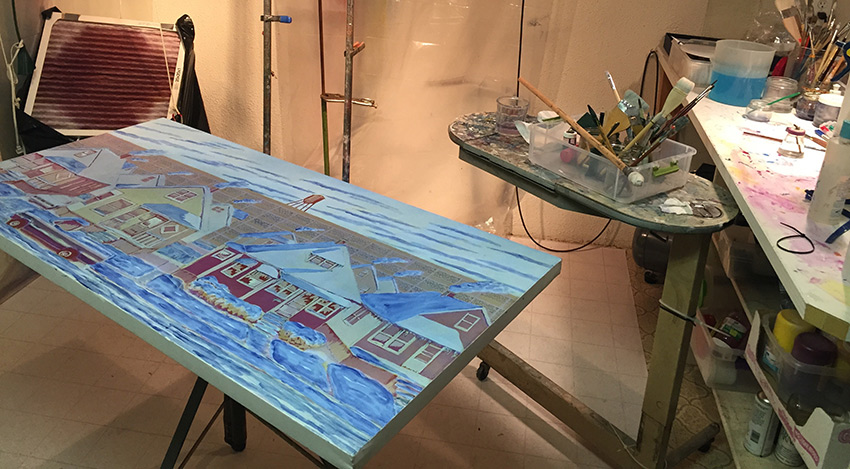
[9] Above: Midway through the blues. The painting will soon become a purple blue mess from the increasing densities of blue and the accumulating purple of the masking solution.
In the background: Excess spray paint is drawn through a furnace filter covering a box fan into a trap bag. As the vehicle for acrylic paint is water there is no issue of toxic fumes. However care is taken not breath in the atomized paint particles which is accomplished by using a high quality face mask and venting the excess spray particles through filter traps.
[10] The blue phase after a few maskings and sprayings. The white clouds of the sky are masked. One will notice that the sky has a touch of yellow from the yellow phase, enough to mingle with the blue and lean it in the aqua direction.
[11] Above: Ready for Splashdown! After hosing and sponging the combined micro points of three primary colors will create the full spectrum of colors of the painting.
One never quite knows the mood of the painting that will suddenly appear. I liken it to the birth of a child. We know the child will have fingers, eyes, arms and legs. But we have no idea of the child's personality.
Suddenly,
from the murky chaos, the painting blossoms into its full spectrum
of colors as the water streaming down the canvas carries away the dissolved
masks. We have dubbed this moment as the "Splashdown", often an excuse for a Splashdown party.
It is
a true "unveiling" of the painting as both artist and onlookers
see the completed work in its full color brilliance for the first time.
While there is a vision of what the painting will be final appearance is always a bit of a surprise. I liken it to the birth of a child. I know it will have hands, legs, eyes and fingers, but cannot know it personality.
Lowell
Boileau
Color Theory of Micropointillism
Microscopic specks of the primary colors yellow, red and blue on a white surface are all my paintings consist of. The viewing eye does the mixing of the thousands of colors that appear.
Primary Color Micropointillism is the technique I use. It is a microscopic variation of Pointillism — the theory and technique of painting practiced by the likes of Seurat, Signac and other Pointillist painters of late 19th century France. Instead of creating colors by mashing pigments together on a palette and spreading them on canvas, the Pointillist painters dabbed masses of individual “points” of pure unmixed colors.
The making of "The Gentle Chaos" -- red phase
[Stuttgart 1992] Lowell Boileau
These points blended by the eyes of the viewers to appear as many different colors depending on the amount and distribution the dabs. At a distance side-by-side blue and yellow dabs gave rise to the illusion green, yellow and red, to the illusion of orange. The Pointillist painters could use up to twenty distinct colors.
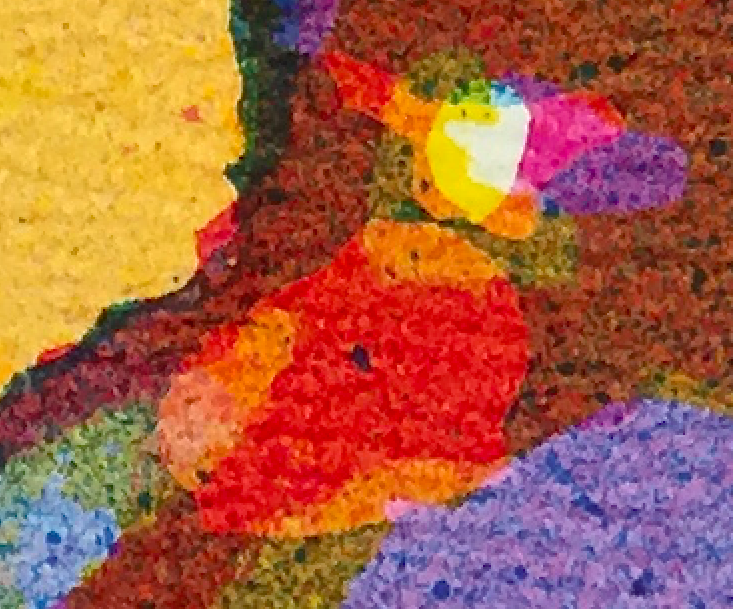
Primary Color Micropointillist paintings use only, as the name implies, the three primary colors of yellow, red and blue atomized to microscopic size points by spraying. To the normal eye the colors of a Micropointillist painting appear solid. However, viewing through a pocket 30-power microscope will reveal that all colors are merely tiny yellow, red and blue dots in varying densities.
The result is a brilliant skin of paint less than 1/100 of an inch thick with white being simply a hole in the skin, the white surface upon which the paint lies. The super-thin color results in a unique and intense luminosity as light easily passes through the thin skin to illuminate the color from behind.
How is this achieved? I like to joke that it takes longer to explain Primary Color Micropointillist painting than to do one. So if you are ready to go into the weeds about how they are made, the following demonstation and documentary video will describe the technique and history of the Primary Color Micropointillist painting technique.
Micropointillism Defining a Medium by Nicolas Boileau
Micropointillism was co-developed by Lowell
Boileau and Stephen Goodfellow in the late 1970's and early 1980's in Highland Park, Michigan, USA.
"Waterworks"
"Waterworks" is a 1983 documentary about MicroPointillist painters - Lowell Boileau & Stephen Goodfellow , the 1980's Detroit Art Scene and a "Splashdown" party.
Director & Cinematography by Rob Handley, Edited by Stewart Shevin.